Annual international conference
New Frontiers
in Geopolitics
Our annual international conference on strategic and geopolitical issues in the contemporary world.
Explore the conference
The following day

Academic year 2026/27
A new year. New perspectives.Dear students,
Welcome to Geopolitical Studies at Charles University. Whether you are joining us for the first time or returning for another year, I am glad you are part of our community.
Bring your questions to class, share your perspective, and take time to listen to one another. Some of the most valuable conversations begin with a question you were almost afraid to ask.
I look forward to getting to know you and hearing your ideas. I hope you will feel at home here in Prague.


Engagement & Events
Upcoming at GPSSave the date
Annual international conference
Our annual international conference on strategic and geopolitical issues in the contemporary world.
Explore the conference
The following day
MA in Geopolitical Studies
The terms Geopolitics and International Relations (IR) have been used interchangeably. Geopolitics, however, is about much more.
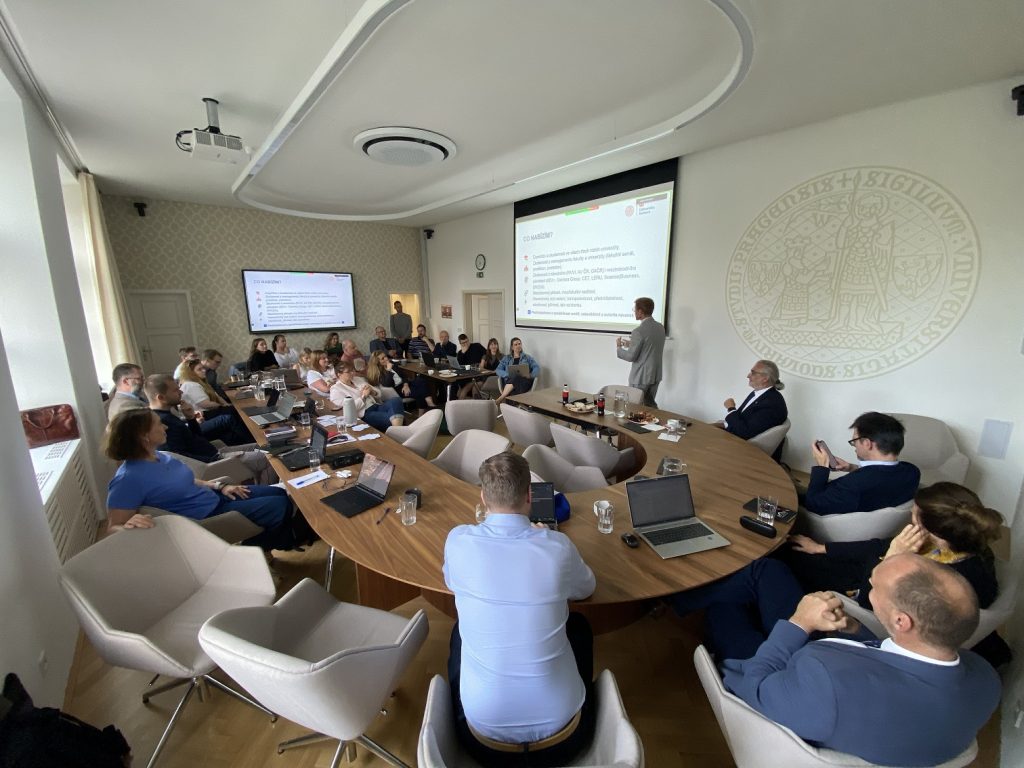
In addition to a robust theoretical and empirical foundation, GPS, as a career-focused program, emphasizes hands-on experience and offers practically oriented courses such as Political Risk Analysis, Geopolitical Debates, Geopolitics of Defence Industry and Arms Trade, or Internship.
Applications for 2027/2028 open on 1 November 2026.
Programs & Training
22–26 June 2026Past edition · Summer school
Geopolitical Summer School · A week of lectures, workshops and student presentations at the Institute of Political Studies.
Our global community
People of GPSThe Geopolitical Studies program brings together diverse perspectives from 60+ countries across 6 continents, creating a truly global academic environment.


A place to belong
Charles University is Central Europe’s oldest university and a major research institution. The Faculty of Social Sciences provides library resources, research support, and academic infrastructure that support graduate-level work in political science and international relations.
Explore life in PragueDouble degree with National Taiwan University
PragueTaipei
Study geopolitical theory from two regional vantage points. This double degree program takes place at Charles University in Prague and National Taiwan University in Taipei. You’ll learn how geopolitical concepts work in both European and East Asian contexts, and you’ll earn master’s degrees from both universities.
Discover the double degree
Why Prague?
Prague sits at a historical pivot point between Western and Eastern Europe. The city’s position in Cold War dynamics, its role in major geopolitical shifts, and its current place in European security debates make it a relevant location for studying spatial dimensions of power.
Discover the Prague pivotGraduation outcomes
Charles University has prepared scholars, diplomats, and analysts from everywhere. Students come here to understand how power operates across space and time. They leave equipped to work in foreign ministries, think tanks, international organizations, and research institutions across multiple continents.
Explore internships